
Guide

What Is Powder Coating?

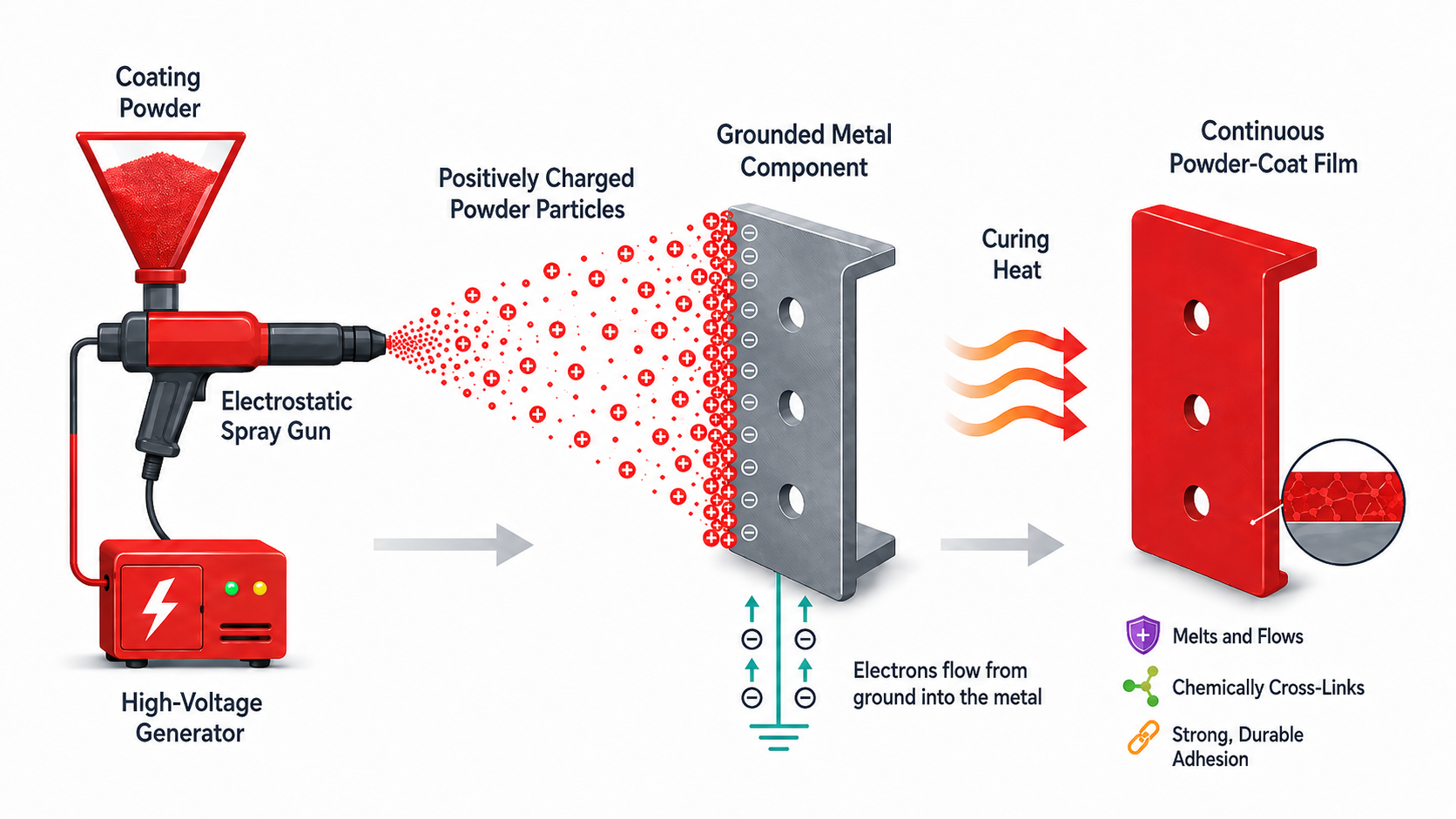
Powder coating is a dry finishing process in which finely ground coating powder is electrostatically applied to a grounded component. The charged powder is attracted to the surface and remains in place until the component enters the curing oven. During curing, the powder melts, flows and chemically cross-links into a continuous, durable coating that adheres strongly to the properly treated surface.

Electrostatic application

Charged powder, grounded component, controlled coverage

The electrostatic charge attracts the powder to the grounded component, helping the applicator achieve efficient and controlled coverage. Complex shapes, deep recesses and difficult geometries may require additional application techniques to achieve consistent coverage.

Operator applying powder coating with an electrostatic spray gun in a workshop

Benefits

Main Benefits of Powder Coating

Powder coating alone does not prevent corrosion. Substrate condition, chemical pretreatment, coating selection and correct curing all contribute to performance.

Strong resistance to scratching, chipping and everyday handling
Excellent colour and finish selection
Clean and consistent factory-applied appearance
Suitable for both custom work and production batches
No conventional liquid solvent carrier during application
Efficient curing without an extended air-drying period
Reclaimable overspray where the production setup and colour-management process allow it
Strong corrosion protection when combined with appropriate chemical pretreatment
Suitability for steel, aluminium and many fabricated metal products

Preparation

Surface preparation and chemical pretreatment are not the same thing

Surface preparation

Surface preparation is the overall process of ensuring that a component is in a suitable condition for coating. It may include inspecting the substrate, identifying rust, oil, old coatings, residues or other contamination, and deciding whether additional cleaning or stripping is required before the standard chemical treatment process.

Chemical pretreatment

Chemical pretreatment is a standard part of Talaween’s powder-coating process for virtually all components. It cleans and conditions the substrate before powder application and is essential for supporting reliable adhesion, corrosion resistance and long-term coating performance.

Without proper treatment, the powder may initially appear acceptable but cannot be relied upon to bond and perform correctly over time. For this reason, chemical pretreatment is included in Talaween’s normal powder-coating process rather than being presented as an optional upgrade.

In limited cases where the standard chemical treatment route is not required or is not suitable for the component, an alternative solvent-cleaning process may be approved. This is a specifically assessed exception, not the standard process.
Rust removal, removal of an existing coating and laser cleaning are not automatically included in every powder-coating job. Where components require additional restoration or stripping, that work is evaluated and quoted separately.

Step by step

How a component moves through the process

  1. Step 1

    Project Assessment

    The material, dimensions, quantity, existing condition, intended use, colour, finish and required delivery schedule are reviewed.

  2. Step 2

    Additional Cleaning or Stripping, Where Required

    If the component has significant rust, old coatings, oxidation or difficult contamination, an additional cleaning or stripping service may be recommended and quoted separately. Laser cleaning is one possible option but is not a mandatory stage in standard powder coating.

  3. Step 3

    Chemical Pretreatment

    Virtually all components proceed through Talaween’s standard chemical treatment process to clean and condition the substrate and support proper powder adhesion and corrosion resistance.

  4. Step 4

    Drying, Masking and Preparation for Coating

    The treated component is dried and prepared for powder application. Masking, plugging or specialised hanging arrangements may be used where required by the component.

  5. Step 5

    Powder Application

    The selected powder is electrostatically applied to the grounded component using controlled spray techniques.

  6. Step 6

    Oven Curing

    The component is heated according to the requirements of the selected powder system. During this stage, the powder melts, flows and chemically cross-links into the finished coating.

  7. Step 7

    Quality Inspection

    The completed component is visually inspected for coverage, appearance and consistency. Talaween also measures cured film thickness before components leave the operation.

  8. Step 8

    Packing, Collection or Delivery

    The finished components are prepared for collection or delivery according to the project arrangement.

A durable powder-coated finish starts long before powder is sprayed. Substrate condition, chemical pretreatment, powder selection, application, curing and final inspection all contribute to the quality of the finished coating.

Applications

Where Powder Coating Is Used

Common components we see every week in the workshop.

Gates and fences
Railings and staircases
Doors and windows
Aluminium profiles
Furniture and decorative metal components
Industrial parts
Shelving and racking
Outdoor metal structures
Machinery parts
Architectural metalwork

Have a project to coat?

Send the item, material, quantity, colour and required date — we will advise on preparation, coating system and finish. Phone and WhatsApp: +962 7 9087 3099.